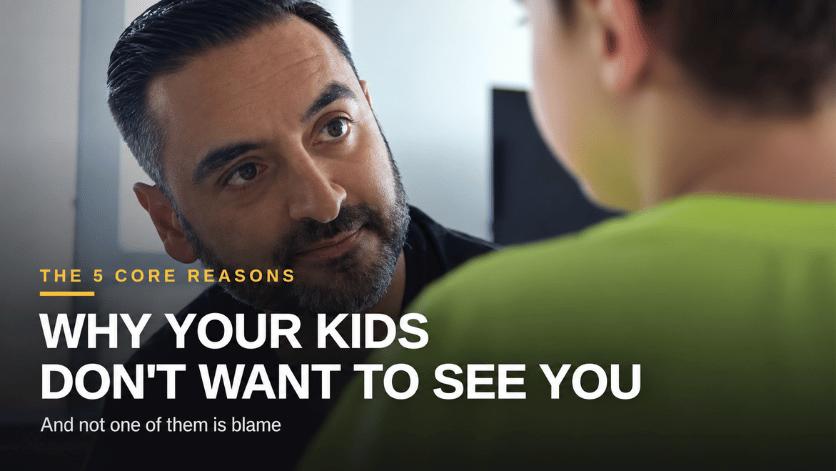
This subject has hit close to home for me lately.
Not in my own house. In the sessions I work in, sitting with parents who are disconnected with their children. Most of the low contact and estranged parents I sit with arrive with the same sentence, and it usually comes out quietly, near the end: “I don’t know what I did.”
So they guess. And in the absence of an answer, most of us don’t guess kindly. We blame therapists on TikTok, or decide our children are narcissistic, or ungrateful, or being turned against us by some external force.
I want to offer you five explanations instead. Not one of them requires you to have been a bad parent.
1. Repair never followed the rupture
A “rupture” is simply an argument. Every family has them, and a family that never argues usually has somebody shrinking so everyone else can stay comfortable.
So the argument is never the problem. What happens after it, is.
When nobody helps a child find their way back to an internal feeling of safety, that activation doesn’t go away. It gets stored. And the next unresolved activation gets stored right next to it.
Think of them like tabs on a computer nobody ever closed. Still open. Still running. Still using up memory.
Most parents couldn’t describe what “repair” actually looks like, and it isn’t because they don’t care. It’s because they never saw it, or had it modelled to them.
2. The apologies were about clearing guilt
There are two kinds of apology, and only one of them lands.
The first sounds like: “I’m sorry. Let’s move past this. Let’s forgive and forget.”
Now, wanting that is natural, because guilt is painful to carry. But each of those asks the other person to hold something so you don’t have to.
In other words, the apology becomes a way to unburden yourself. And on the receiving end, that lands as being “managed” rather than being met.
So if you’ve ever asked yourself how much more you could possibly apologize, it may not be the apology your kids are rejecting. They likely don’t believe you understood the impact. And while that stays true, some part of them stays braced for it happening again.
3. Love was experienced as conditional
Most parents would argue for the fact that they love their children unconditionally. The problem is that often love can be experienced as conditional — tied to grades, to achievement, to staying easy to manage, keeping a positive mood, even on the days they weren’t feeling that way.
Often it’s a standard nobody said out loud, which means it can never quite be met.
Gordon Neufeld, the developmental psychologist, put it simply: children must never work for our love; they must rest in it.
When love feels conditional, a child seeks distance from wherever the condition lives. A fully grown adult child will often do the same. That isn’t them not loving a parent back. It’s often some part of them that is still trying to not fail a test.
4. The emotional labour ran one way
Some children get handed a role early, and it goes something like this: I must shift who I’m being so I can manage how the adult is feeling, and that way I can stay safe.
Also known as “walking on eggshells.”
You might see it looking back. Or it might be too confronting to look at. Regardless, it’s often experienced as the child learning to scan, to watch, to read the mood before anyone has spoken — while their own feelings got smaller, because the adults were taking up the room.
This isn’t a dig at parents. Most of us were simply never shown how to hold a child’s emotions without making those emotions mean something about us. Nobody taught it to us. It was inherited.
A kid who grows up taking on that role eventually will get exhausted by it. So if visiting a parent now means picking that job back up, consider the possibility that your adult children may not be avoiding you. They’re simply declining that job. And trying to put down that role.
5. They’re protecting the next generation
Something happens to a person when they have a child of their own. They start watching the relationship they’re building, and it stirs up memories of what they didn’t get themselves as a child. I remember this happening with me.
Having a child can be one of the most triggering things a person goes through, and most of us were simply not prepared for it.
Now bring the grandparent into that picture. If your adult child watches you with their kid, and there’s something incomplete within them, something unresolved they haven’t felt, seen, or noticed yet, it can often flare up a defensiveness they didn’t even know was hiding there when they watch you treat their child in a similar way that confronted them in the past.
That isn’t a rejection of you, the parent, though it often gets felt that way from where you’re standing. I understand why it can look like being shut out of your own grandchild’s life for no reason you can point to.
None of this means the story is finished
I want you to know that none of this means the story is finished.
Every one of those reasons above was passed down before it was passed on. That isn’t an excuse. It’s exactly why this can change.
If you are a parent with a strained relationship with your adult child, and you have the willingness to look at this with curiosity instead of defensiveness, it can heal — not by demanding an explanation, and not by playing the victim, but by understanding what actually happened, even where you don’t fully agree with their perspective.
Watch the video above, and pay close attention to what arises in your body while you do. That reaction is valuable information.
This work isn’t for those who need to be right. But if you’re ready to lean in, the next step is a pattern clarity call, where we look at the blind spots that may have been missed and carve out a path where you become a place of safety rather than something your children are unconsciously bracing against.
Your guide on the side,
Nima